Investigation · Municipal finance & utility costs · White, S.D.
White utility costs and the financial records behind them
A residential customer receiving White city water, sewer, electricity and one garbage can’s service starts with $182.45 in monthly base charges and surcharges. That is $2,189.40 a year before electricity consumption, additional water use and applicable sales taxes. The water base charge includes the first 2,000 gallons.
Of that starting amount, $100.45 a month is surcharges: $93.95 for four water and wastewater projects and a $6.50 electric surcharge. The remaining $82 covers the water, sewer and electric base charges and one garbage can. The electrical surcharge is separate from the four water and wastewater project charges.
Where the $182.45 goes, per month
- Base charges and one garbage can$82.00
- Phase I water surcharge$27.60
- Phase II water surcharge$14.75
- Phase I sewer surcharge$30.00
- Phase II sewer surcharge$21.60
- Electric surcharge$6.50
Source: City of White posted utility rates and surcharges
Behind the bill is a longer question about financial oversight. White’s completed 2022 audit bears an auditor’s report dated February 5, 2026, more than three years after the period it covers. It repeated a material weakness in revenue controls and reported $46,519 in General Fund disbursements above adopted appropriations. Subsequent records reviewed for this story describe financing activity continuing while later audits remained unfinished.
The four water and wastewater projects had combined estimated costs of about $9.35 million. That is not $9.35 million in debt: grants and potential loan forgiveness reduce the repayable portion. But the loan awards carry 30-year terms, and the project charges are already on the City’s posted rate schedule.
Who keeps the books and who checks them
White operates under an aldermanic form of government. Voters citywide elect the mayor, and ward voters elect six aldermen. Together, those seven elected officials form the Common Council. The finance officer is appointed and performs the day-to-day financial work; maintaining the books and overseeing that work are separate responsibilities.
In Aug. 27 correspondence with Silent Investigative, Auditor General Russell A. Olson wrote: “It is the responsibility of the municipality, mayor or common council, to oversee the operations of the finance office.” Olson’s statement assigns formal responsibility; it does not establish how that oversight operated in White.
“It is the responsibility of the municipality, mayor or common council, to oversee the operations of the finance office.”
Russell A. Olson, South Dakota Auditor General, Aug. 27 correspondence
Under SDCL 9-8-1, White’s mayor is the city’s chief executive officer. Olson wrote that in White’s aldermanic form of government, “the mayor is considered the chief executive officer,” with oversight of the finance office resting with “the municipality, mayor or common council.”
The published records reviewed for this article did not document a recurring independent review of completed bank reconciliations, deposits or financial reports through Dec. 31, 2022. Absence from the published record does not prove that no review occurred; it identifies the documentation still needed to establish who reviewed what, when and with what result.
The combined 2020-2021 audit said inadequate segregation of revenue duties had been cited repeatedly since 2011. The 2022 audit repeated the finding, reporting that the finance officer could receive money, issue and record receipts, prepare deposits, reconcile bank statements and prepare financial statements. The record establishes a recurring control weakness; it does not establish that identical conditions existed without interruption in every intervening year.
Auditors classified the condition as a material weakness: a reasonable possibility that a material misstatement would not be prevented, or detected and corrected, on time. The finding does not prove theft, fraud, diverted funds or a cash shortage, and no such evidence has been established in the records reviewed for this story.
The audit attributed the condition to limited staffing, and management reported employing one full-time finance officer. In a small municipality, compensating controls—such as a documented second review, dated approvals and follow-up on exceptions—can address duties that cannot be fully separated.
In the corrective-action plan appended to the 2022 audit, City management said the finance officer had been including the mayor and supervisor on all “major transactions” and acknowledged that segregation problems would continue. The plan did not define “major transaction” or describe recurring, documented review of completed monthly reconciliations. Feb. 12, 2026 was labeled an anticipated completion date, not a signature or proof of implementation. The auditors applied required limited procedures to the response but did not subject it to the other procedures used on the financial statements or express an opinion on it.
What an unmodified opinion does and does not mean
The 2022 financial statements received an unmodified opinion under White’s modified cash basis of accounting. That means the auditors concluded that the final statements were fairly presented, in all material respects, under that basis.
The opinion did not erase the separate findings, express an opinion on the effectiveness of the City’s internal controls or certify that every transaction was examined. The engagement was not a fraud investigation, and a 2022 opinion cannot establish whether balances published for later, unaudited years are accurate.
Four years beyond adopted budget lines
Audit reports documented expenditures above adopted appropriations in four consecutive years, from 2019 through 2022. For 2019, the prior-findings schedule said several General Fund departments exceeded appropriations but did not quantify the amount. The cited overages were $831.13 in 2020, $24,418.85 in 2021 and $46,519 in 2022—a three-year quantified total of $71,768.98, plus the unspecified 2019 amount.
For 2022, auditors reported cash disbursements above appropriations in seven departments or activities and expressly identified the condition as noncompliance with SDCL 9-21-9. The audit said the condition weakened budgetary control and limited the council’s ability to oversee public resources.
These are gross department- or activity-level overages, not a finding of missing cash, theft or improper purpose. Only the 2022 audit expressly labeled its condition noncompliance with SDCL 9-21-9. White’s 2020 and 2021 budgets contained contingency funds, but the audit showed no transfers and no changes between the original and final budgets; management said it would use contingency transfers or supplemental budgets when legally permitted.
The combined 2020-2021 audit is dated June 5, 2023. Two months later, council minutes said “most” recommendations had been addressed but did not identify the changes or show that they had been tested. The 2022 audit later repeated the control finding; because it covered conditions only through that year, it does not establish whether later changes were effective.
The audit record fell years behind
- Combined 2020–2021 audit report dated.
- Council minutes say “most” recommendations addressed; changes not identified.
- Council minutes: White two audits behind; prior audit firm no longer accepting municipal work.
- Council approves a new audit firm for a combined 2022–2023 engagement.
- Completed 2022 audit report dated.
- DLA approves the same firm for the 2023 audit.
- Auditor General: 2023 audit in progress and unfiled; 2024 and 2025 to follow.
- 2022 is still the latest posted White audit.
By June 2024, council minutes said White was two audits behind, its prior audit firm was no longer accepting municipal work and a CPA was needed to correct the accounts. In September 2024, the council approved a new audit firm for a combined 2022-2023 engagement. The completed 2022 report is dated Feb. 5, 2026.
DLA approved the same firm for the 2023 audit on February 20, 2026. Olson said on August 25 that the 2023 work was in progress and unfiled, with 2024 and 2025 to follow. A September 23 review of the public audit record still identified 2022 as the latest posted White audit.
DLA also posted an untimely-audit notice stating that White had not submitted a timely audit report for the one-year period ended Dec. 31, 2024. The notice says the City may be subject to a $10-per-day penalty; the reviewed record does not establish that a penalty was imposed, waived or paid. DLA’s current list of untimely-audit notices names 13 cities, including Pierre and Sturgis, so late audits are not unique to White.
The available record does not establish who caused the delays. It lacks a complete auditor request log, City delivery timeline, fieldwork chronology, draft and revision dates, state-review timeline and engagement amendments. Responsibility could lie with the City, its records, one or more accounting firms, state review or a combination. The evidence does not support assigning blame without those records.
Source: White untimely audit notice
Source: DLA reports index and untimely-audit notices
Published figures that require a bridge
The City’s published annual reports are useful starting points, but Olson wrote that they contain reporting errors and must be treated as unaudited information. The City-published 2022 Water Fund ending balance of $331,511.24 was $62,080.76 below the final audited balance of $393,592.
Separately, the same annual report’s $1,911,334.75 depository schedule exceeded the $1,798,733.57 sum of its four displayed ending fund balances by $112,601.18. The published 2024 ending balances for the General, Water, Sewer, Electric and Garbage funds also did not carry into the corresponding 2025 opening balances; the five differences netted to a $188,623.72 decrease.
Those differences are reconciliation questions, not evidence that cash disappeared. Audit adjustments, closing entries, reclassifications, restricted project funds or corrections may explain them. But an account-level bridge is needed to show what changed. May 5, 2025 council minutes report that the finance officer had to “force reconcile” for 2020 through 2024 and say some figures might be skewed, without identifying the affected entries, amounts, approvals or supporting workpapers.
Olson said most issues the audit firm had identified at that point involved administrative errors. He described financial-statement auditing as risk-based and said auditors could expand procedures if evidence indicated misappropriation or fraud. That is Olson’s account, not an independent finding that all differences were administrative or that no transaction-level error or wrongdoing existed.
Source: May 5, 2025 council minutes
What the financing figures mean
The named assistance awards total $9,349,900, slightly less than the $9,350,742 combined project estimates. Of the awards, $6,175,999 is face-value loan authority and $3,173,901 is direct grants. DANR’s 2025 annual report lists $700,000 in principal forgiveness awarded on the Phase II drinking-water loan; that forgiveness is already inside the loan award and must not be counted as another award on top.
If all four loans are fully drawn and the full $700,000 forgiveness applies, repayable principal would total $5,475,999 before principal repayments. That is a financing scenario, not a verified current debt balance. Executed agreements, disbursements, forgiveness actually credited and principal already repaid determine the City’s outstanding obligation.
Phase I water $1,786,189 loan award and $715,611 ARPA grant. DANR’s 2025 loan portfolio lists a 1.625 percent rate and 30-year term.
Phase I sewer $1,832,810 loan award and $734,290 ARPA grant. DANR’s 2025 portfolio lists a 2.125 percent rate and 30-year term.
Phase II water $1,452,000 loan award, including $700,000 in awarded principal forgiveness, plus a grant capped at $665,000. The reported loan rate is 3.50 percent for 30 years.
Phase II sewer $1,105,000 loan award plus a grant capped at $1,059,000. The reported loan rate is 3.50 percent for 30 years.
Source: DANR 2025 drinking water annual report
Source: DANR 2025 clean water annual report
Source: March 27, 2025 Board minutes and award conditions
Interest and applicable administrative charges add to principal over the life of the loans. This story does not assign a final lifetime repayment total because the executed repayment schedules have not been established in the records reviewed. DANR’s payment tables do separate the two for Phase I: the 1.625 percent water rate is 1.375 percent interest plus a 0.25 percent administrative surcharge, and the 2.125 percent sewer rate is 1.875 percent interest plus the same surcharge. Whether the 3.50 percent Phase II rates include that surcharge has not been established.
White’s Phase II applications were filed before the 2022 audit was issued and used City-prepared financial schedules. The drinking-water application said the 2023 and early-2024 records were “not as clear as could be”; the wastewater application disclosed “mathematical inconsistencies” in figures taken from City records. State program materials expressly permit audited financial statements or unaudited annual reports. The public file does not establish every attachment or reconciliation the State reviewed, and it does not prove that an unaudited error caused a surcharge or that any financing action was unlawful.
The cost is already visible on the City’s posted rate schedule: $27.60 for Phase I water, $14.75 for Phase II water, $30 for Phase I sewer and $21.60 for Phase II sewer. For a customer billed for both utilities, those four project surcharges total $93.95 per month, or $1,127.40 per year, before base charges, usage, garbage, electric service, taxes and fees. The Phase II surcharge resolutions call for annual review and allow adjustments; the posted amounts are not guaranteed to remain unchanged for 30 years.
Which council approved which phase
Phase I’s state awards were approved in May 2022 under Mayor Scott Gladis. In September 2023, with Gladis still mayor, the council approved the local Phase I bond and surcharge measures. Phase II also began under Gladis: application authority came in late 2024 and state awards in March 2025.
Matt Lagerstrom was sworn in as mayor on May 5, 2025. That meeting also approved a Phase II engineering agreement with the project’s engineering firm. Under Lagerstrom, the council approved the Phase II local bonds and $14.75 water and $21.60 sewer surcharges on October 6, 2025. Together those two charges add $36.35 a month, or $436.20 a year. At its January 5, 2026 regular meeting, the White City Council approved Resolution 2026-02, increasing water and electricity rates.
Source: January 5, 2026 council minutes
State awards, local bond authorization, loan closing and the actual release of money are separate events. A vote authorizing borrowing does not establish how much has been drawn or how much remains unpaid.
DANR says its safeguards support continued financing
In September, Silent Investigative asked DANR to confirm the status of White’s financing, to address specific items in its feasibility findings under SDCL 46A-1-52 and to produce related records under SDCL chapter 1-27. DANR responded on September 18 that it saw no basis to pause or halt White’s financing. The department said it knew of the City’s audit status, had discussed it with Auditor General Russell Olson and relied on additional review and risk mitigation to address the control concerns.
DANR described reimbursement documentation, multiple levels of staff review, monitoring and authority to withhold payments when supporting documentation is insufficient. Those are meaningful safeguards.
The department also reported that Phase I sewer assistance and both Phase I ARPA grants had been fully disbursed for eligible project costs. It identified $131,056 still available under the Phase I water loan, said Phase II construction and funding were underway and reported that repayments on the Phase I loans were current.
Those statements narrow the unanswered questions. DANR’s response does not identify the particular White records tested, the reconciliations received or the results of its additional review. A reimbursement check can establish support for an eligible project expense without establishing that all City cash balances, utility collections or annual financial reports have been independently reconciled. The response also did not address the request for records under SDCL chapter 1-27 or the feasibility-findings request.
Nor does the response state the current debt balance. Its reported $1,655,133 water-loan figure plus $131,056 available equals the original $1,786,189 authorization exactly. Because repayments do not restore a loan’s available balance, the $1,655,133 figure appears to represent cumulative draws, not unpaid principal. DANR’s 2025 annual report showed $968,044 drawn on that loan as of Sept. 30, 2025. If the $1,655,133 figure represents cumulative draws, as the arithmetic indicates, draws over the year after that report would total about $687,000.
DANR’s position is evidence of its decision and stated safeguards. It is not an independent audit of the City’s books. Conversely, the audit’s material weakness does not establish that DANR reimbursed an improper expenditure. The underlying review records are needed to assess those questions.
More work is being considered
September council records describe a Chapter Three proposal for West First Street, East Main Street and the sewer ponds, with construction targeted for 2028–2029. The reviewed record does not establish a final project price, financing package or household surcharge for that proposal.
Separately, DANR’s June 25, 2026 Clean Water Intended Use Plan lists White project C461118-02 for approximately 2,000 feet of storm sewer. The priority list shows an estimated $325,000 loan and expected terms of 4 percent for 30 years. The state Board of Water and Natural Resources voted unanimously that day to place the project on the State Water Facilities Plan and the Clean Water priority list. The board’s September 24 agenda does not list a White funding application. Those planning figures are not proof that the loan has been awarded, closed or drawn. The storm item should not be added to current debt without those records, or assumed to be the whole of Chapter Three.
Source: June 25, 2026 Clean Water Intended Use Plan, printed page 22
Source: June 25, 2026 Board of Water and Natural Resources draft minutes
DANR says the decision to pursue future projects begins with the City. The financing questions remain: what will the work cost, what assistance will be available, how much would residents repay and what would the cumulative bill become? No reliable household forecast for Chapter Three can be calculated from an unspecified financing package.
Tax growth does not establish household capacity to pay
Municipal tax totals do not answer whether households can absorb fixed utility charges. South Dakota Department of Revenue data show White’s municipal tax due rose 5.83 percent in 2025, from $153,540.67 to $162,493.60. But the Catalog and Mail-Order Houses category increased by $9,264.93—more than the City’s entire $8,952.93 increase—while every other classification combined was $312 lower.
DOR’s municipal reports include sellers located in White and sellers elsewhere reporting White tax, including deliveries into the city. The catalog and mail-order classification does not identify the seller’s location, the customer’s residence or all online commerce. Its $33,543.19 in 2025 was 20.64 percent of White’s total municipal tax due; it is not evidence that 20 percent came from outside the city. Headline tax growth alone does not establish broad growth among White-based businesses, resident income or household capacity to pay higher fixed charges.
Source: DOR 2025 municipal tax report by industry
White’s municipal tax due rose 14.53 percent in 2023, from $104,076.70 to $119,195.62, and another 28.81 percent in 2024, to $153,540.67. So far in 2026 the direction has reversed. For January through August, DOR’s monthly municipal comparisons show White at $97,927.01 versus $121,861.24 in the same 2025 period, a decline of 19.64 percent. Those figures establish a reported decline but not its cause. Late filings and amended returns can affect a filing-period comparison.
Source: DOR historical municipal reports and monthly comparisons
Are you charging White’s 2% tax when you don’t have to?
For businesses and customers in ZIP code 57276, the practical question starts with the transaction’s location. A White mailing address alone does not establish that White’s 2 percent municipal sales tax applies. DOR’s July 2026 Municipal Tax Guide lists White’s general rate at 2 percent, city code 388-2. The physical boundary and the applicable sourcing rule determine whether a sale belongs to White.
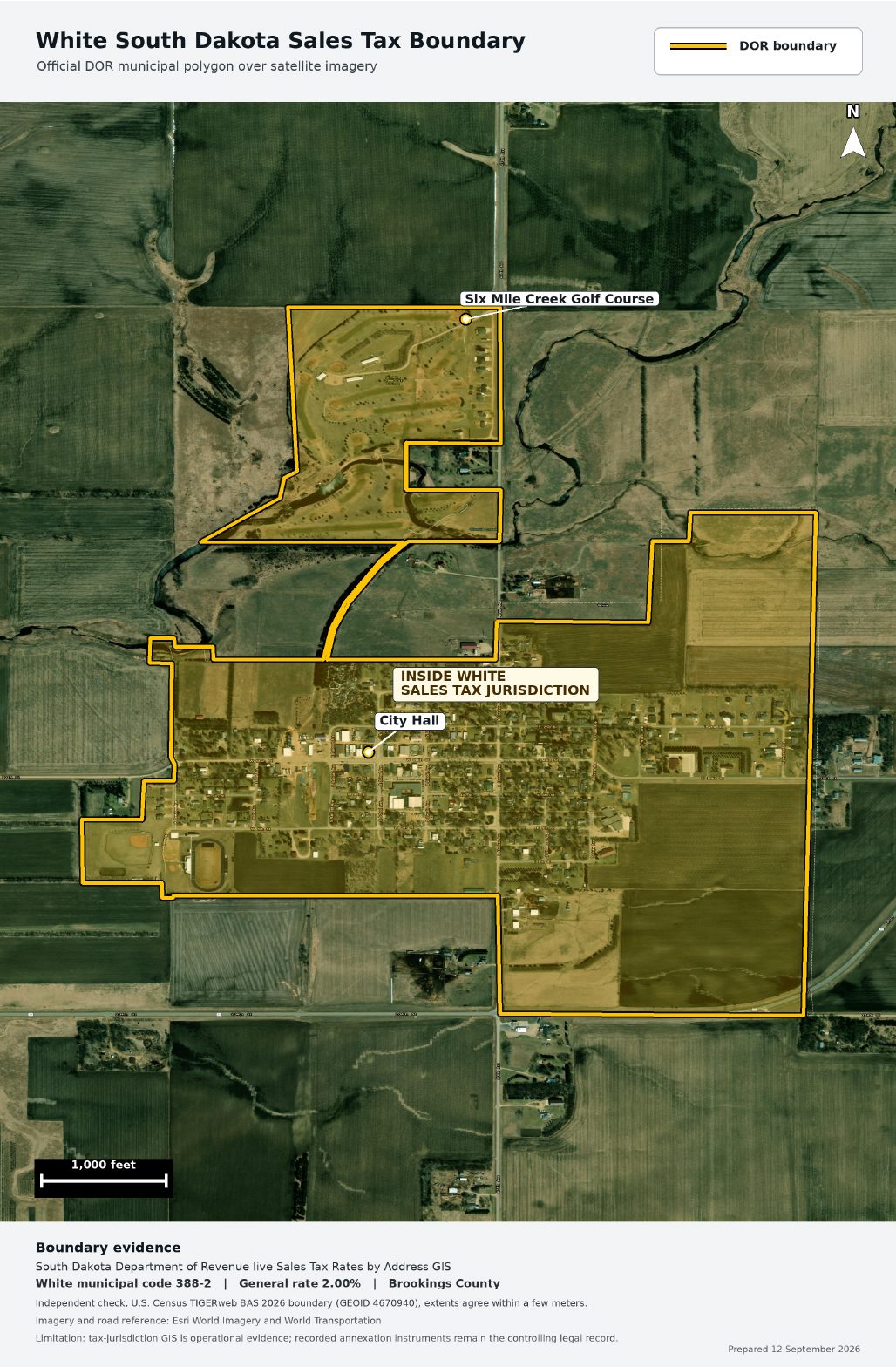
For an ordinary taxable product, DOR generally places the sale where the customer receives it. A rural resident who picks up an item at a White business generally pays the applicable White tax. A taxable item delivered into White generally carries White tax even when the seller is elsewhere. A delivery to a rural 57276 address outside the city generally does not carry White’s 2 percent merely because the mailing address says White. Another jurisdiction’s tax or a special sourcing rule may apply.
The same principle works in both directions. A business based inside White does not automatically owe White tax on every delivery outside town, and a business based outside White can have White-taxable deliveries. Services, rentals, repairs and electronic products have sourcing rules that must be checked for the particular transaction. Properly documented exemptions and resale transactions also need separate treatment.
Contractors must distinguish White sales or use tax from the separate 2 percent state contractor’s excise tax. Qualifying real-property construction is subject to the excise-tax rules, while sales or use tax can apply to the contractor’s materials. Pickup, delivery, use and credits for tax already paid all matter. The contractor’s office address does not settle those questions. Some services performed by contractors fall under sales tax instead of construction excise tax.
An unnecessary 2 percent city-tax line adds $20 to a $1,000 sale and can make a quote less competitive. That example is not a finding that any particular business is overcharging. Sellers remain responsible for tax that is legally due, whether they charge it separately or include it in their prices.
Before changing an invoice or checkout setting, check the physical address in DOR’s Sales Tax Rates by Address tool and confirm how the transaction is sourced. For a boundary address, unusual service or suspected past overcollection, contact DOR Business Tax at 1-800-829-9188 or bustax@state.sd.us. Ask how to correct the customer charge and the tax return; do not treat tax already collected as extra business revenue.
A companion page for businesses and customers shows DOR’s boundary map for White, common situations and four charts of where the tax comes from. A downloadable workbook preserves every published category row from DOR’s 2020–2025 annual reports and its January–August 2026 monthly reports. DOR category records before 2020 were not located for this review. The rules described here were checked against DOR’s published guidance; this reporting has not obtained a DOR ruling on any specific transaction.
Source: DOR Sales Tax Rates by Address
Source: DOR Municipal Tax Guide, July 2026, pages 3 and 11
Source: DOR Sales and Use Tax Guide, July 2026, pages 5–6
Source: DOR Contractor’s Excise Tax Guide, July 2026, pages 5–7, 9 and 11
Supporting reports
The detail behind the sales-tax section:
- White’s 2% sales tax: where it applies and where the money comes from — boundary map, common situations for businesses, and four charts
- White Tax Categories and History, 2020–2026 (Excel workbook) — every published DOR category row, with source page for each
What remains to be established
On September 7, Olson wrote that he and the previous Auditor General, Martin Guindon, who served from 2000 to 2020, had worked with and consulted the independent CPA responsible for the 2017–2018 audit. His statement establishes involvement but not its dates, duration, scope or specific actions. It does not establish continuous knowledge since 2011 or that DLA performed that audit.
After receiving an anonymous tip, Silent Investigative submitted records and questions to DLA in August 2026. Olson contacted the current independent audit firm and, by his account, a White council member, and said DLA would monitor the unfinished audits.
The remaining work is specific: establish the current status of the 2023–2025 audits; document compensating controls and independent review of reconciliations; explain the differences between published and audited figures; obtain executed loan agreements, draw histories and repayment schedules; and show how surcharge collections are reviewed against actual debt and system obligations.
Records supporting DANR’s additional review could materially change the assessment. Documented testing and correction would strengthen the department’s position. Unresolved discrepancies in the underlying records would strengthen the case for further examination. Until those records are available, neither conclusion should be assumed.
Requests to meet with City officials
Silent Investigative has sought to meet in person with Mayor Matt Lagerstrom and City Council President Cody Sunderland, the Ward I alderman whom the City also lists as finance officer supervisor. Sunderland did not respond to repeated calls. The mayor said he would not meet with the researcher and other concerned residents without the city attorney present.
Any response the City provides after publication will be reviewed against the records cited in this report and given due legal diligence. By accepting federally funded ARPA grants and State Revolving Fund loans, the City agreed to the federal financial-management, internal-control and record-keeping requirements that come with those funds.
Disclosure
Silent Investigative Research & Media, LLC is an independent research and reporting firm that works nationwide on fraud, waste and abuse of taxpayer money in government. It is based in White; its principal researcher, Michael A. Fluit, is a White homeowner and utility ratepayer. Silent Investigative prompted the DLA correspondence quoted here, made the September request to DANR, and has referred the “force reconcile” entries to the U.S. Treasury Office of Inspector General, which does not disclose complaint status. This report accuses no individual of theft, fraud or intentional wrongdoing.